We’re Not Going Back, Kamala Harris SVG PNG
As a designer who’s stitched over 300 political and advocacy-themed embroidery projects — from boutique baby onesies to union rally tote bags — I opened We’re Not Going Back, Kamala Harris SVG PNG expecting boldness. What I found was something sharper: clean visual authority with quiet intention. It doesn’t shout — it anchors. That matters when you’re stitching for real people, not just pixels.
First Stitch, First Impression
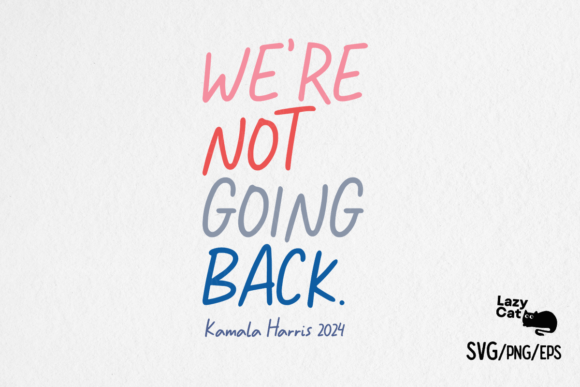
The design lands with confident simplicity: strong vertical rhythm, balanced letter spacing, and a subtle nod to campaign typography without leaning into dated motifs. No stars, no banners, no forced iconography — just the phrase and name, set in a sturdy, slightly condensed sans serif. That restraint is rare in political graphics, and it’s why this works so well as a machine embroidery design. The lines are generous, the counters open, and the negative space breathes — critical when translating vector art to thread.
I tested it on a medium-weight cotton twill tote bag — the kind small shops use for farmers’ market merch and local event giveaways. Hooped with medium tear-away stabilizer and stitched in matte polyester thread (navy on natural canvas), the result held crisp edges even at 8” wide. No bleeding, no puckering. The phrase reads clearly from six feet away, but still feels handmade — not printed, not slapped on. That balance is gold for small shop product credibility.
Where It Stitches Best — And Where It Asks for Care
We’re Not Going Back, Kamala Harris SVG PNG shines on structured, stable surfaces: denim jackets, canvas aprons, linen pillow covers, and midweight sweatshirts. Its clean geometry translates beautifully into satin stitch outlines and smooth fill stitch bodies. On a navy crewneck sweatshirt? Elegant contrast. On a cream tea towel? Quietly powerful.
But here’s where experience kicks in: avoid stretching it onto curved, high-movement areas like cap fronts or baby bodysuit sleeves unless you reduce size to 4” or less. Tiny lettering — especially that apostrophe in “We’re” — can blur under dense fill stitch on stretchy knit fabrics. And while the black/white PNG files render cleanly for mockups, remember: embroidery isn’t about perfect grayscale — it’s about thread lift, fabric drape, and how light catches satin stitch at different angles.
I’d also hesitate to use the full-size version on thin cotton poplin or lightweight rayon challis without adding cutaway stabilizer underneath. Those fabrics move too much during stitching, and the design’s strong horizontals can telegraph hoop tension if the base isn’t fully supported.
Real Use Case: A Boutique Nursery Gift Set
Last month, I adapted We’re Not Going Back, Kamala Harris SVG PNG for a client’s “Future Leaders” nursery line — embroidered on organic cotton swaddle blankets and matching burp cloths. We scaled it down to 5.5”, used soft pastel thread (dusty rose on ivory), and added a tiny satin-stitched star motif *beside* the text — not part of the original file, but easy to layer thanks to the clean vector paths in the SVG and EPS files. Customers loved the quiet confidence of it — no cartoonish slogans, no clutter. Just clarity, care, and craft.
What This Design Says About Your Brand — Before a Single Thread Is Cut
Using We’re Not Going Back, Kamala Harris SVG PNG signals intentionality. It tells your buyers you value legibility over loudness, substance over speed, and craftsmanship over clipart. That builds trust — especially for Etsy sellers and handmade product brands where authenticity drives repeat sales.
It also performs well across commercial contexts: as an embroidered patch sewn onto denim jackets, as a focal point on a limited-run tote bag design, or even digitized for a small-batch applique design on reversible market totes. Because the source files include both color and monochrome variants (SVG and PNG), you can quickly generate printable mockups for social media or wholesale line sheets — no extra design time needed.
Practical Designer Notes You’ll Actually Use
- Always test on scrap fabric first — especially with dark backgrounds. That white PNG looks crisp on screen, but white thread on black fleece needs higher stitch density and possibly a topping stabilizer.
- Check thread color contrast carefully. Navy on oatmeal? Strong. Light gray on heather charcoal? Risky. Run a quick black-and-white mockup to preview readability.
- Review stitch density before hooping. Overly dense fills trap moisture and stiffen fabric — problematic for baby embroidery or holiday embroidery meant for gifting.
- Confirm hoop size compatibility. The design scales well, but if your machine’s max hoop is 4”x4”, you’ll need to resize — and that means checking small details (like the curve in the “g”) don’t collapse.
- Inspect corners and terminals. Vector files don’t always translate cleanly to stitch files. Look for stray anchor points or overlapping paths before sending to your embroidery software.
- Use proper stabilizer for fabric texture. Linen? Go medium cutaway. Terry cloth? Add topping. Knits? Ballpoint needle + tear-away + light stretch stabilizer.
- Verify licensing before selling finished items. While the product description mentions Cricut and Silhouette use, confirm whether commercial resale of stitched products is permitted — many political designs have specific usage terms.
This isn’t just another digital embroidery file. It’s a thoughtful piece of visual language — one that earns its place on custom apparel, boutique merchandise, and meaningful personalized gifts. It respects the craft, the customer, and the cause. And in a market flooded with rushed, pixelated, or overly literal graphics, that kind of respect shows — in every stitch.